Why boardrooms swing from empty to overloaded
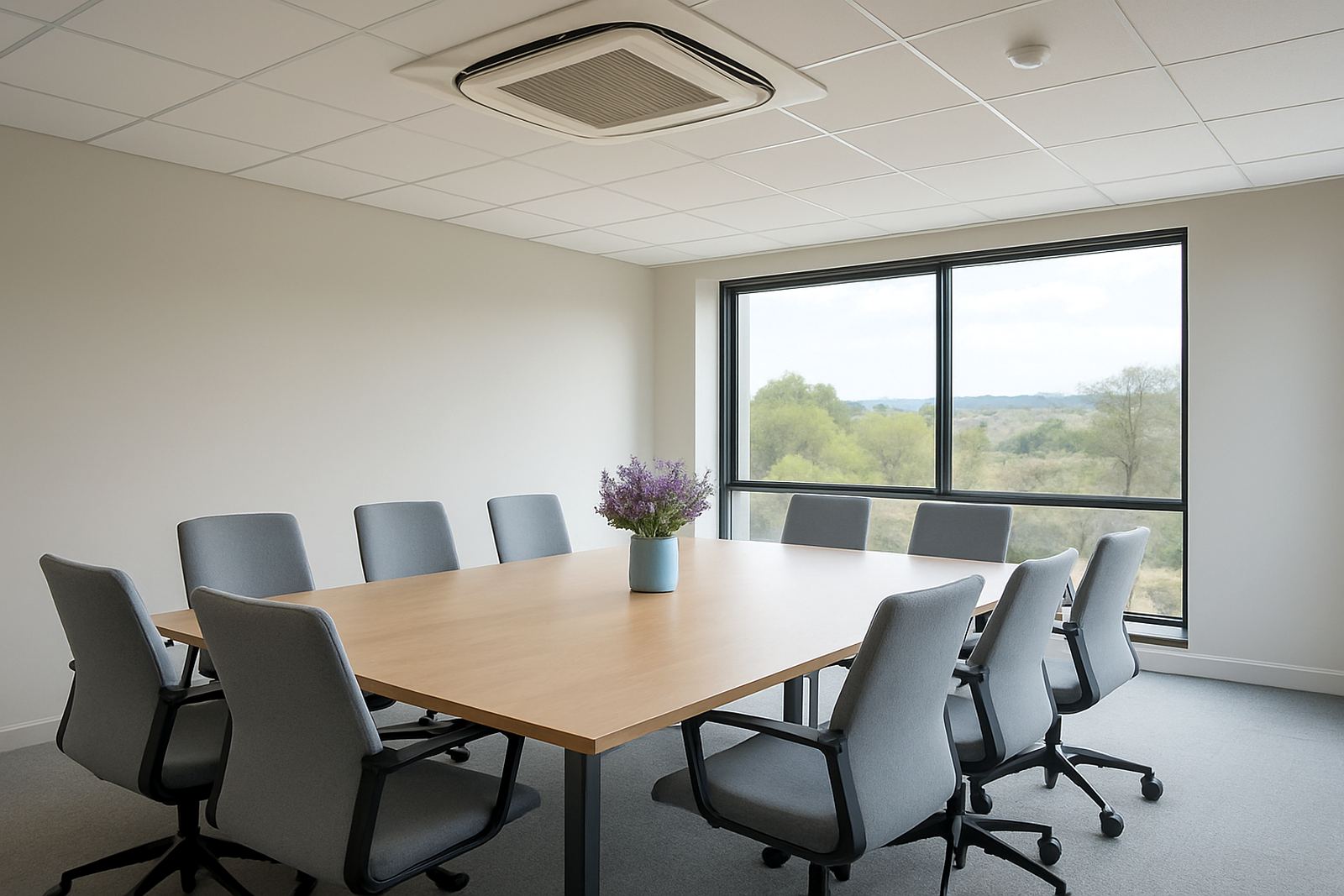
A boardroom is one of the hardest spaces to condition well because the heat load changes so fast. A room might sit empty for most of the morning, then fill with eight or twelve people, laptops, screens, hot coffee and a door opening every few minutes. In Johannesburg and Pretoria, that change can be enough to push a room from comfortable to stuffy in a short space of time.
Unlike open-plan offices, meeting spaces are not used in a steady pattern. One day the room is booked back to back, the next it is empty after lunch. If the air-conditioning is sized only for average use, it often runs too hard when the room fills and too lightly when the room sits unused. That is where zoning and proper controls earn their keep.
How occupancy affects temperature, air movement and noise
People think cooling is only about temperature, but in a boardroom the other factors matter just as much. Fresh air delivery, humidity, noise from fan units, and the position of supply grilles all affect how the room feels. A packed meeting room in Sandton can become warm and stale even when the thermostat says the temperature is fine.
- Body heat adds up quickly, especially in smaller rooms.
- Closed blinds can trap heat from north-facing windows.
- Presentation equipment and screens add a constant load.
- Low airflow makes the room feel flat and uncomfortable.
- Too much cold air can cause complaints from people sitting under a diffuser.
When these factors are ignored, staff start opening doors or switching the system on and off manually, which usually makes the problem worse and wastes power.
What zoned control changes in a meeting space
With a zoned ducted system, the boardroom can be treated as its own area. Motorised dampers direct more or less conditioned air into the room depending on how it is being used. Smart thermostats and occupancy-linked settings let the system respond to real demand instead of guessing. That means the room can recover quickly before a meeting starts and then back off once everyone leaves.
This approach is useful in offices that mix private meeting rooms with general open areas. If the boardroom is cooling faster than the rest of the office, it should not pull the whole system out of balance. Proper zone design keeps the airflow where it is needed and helps avoid that common problem where one person is freezing while another is sweating by the window.
- Room-by-room dampers reduce wasted cooling in empty spaces.
- Controls can be set for meeting times and after-hours use.
- Temperature recovery is faster before a scheduled session.
- The rest of the office is less affected by a busy boardroom.
A local example from a Pretoria East office
A mid-sized office in Pretoria East recently called about a boardroom that was comfortable for two people but overheated as soon as the management team met there. The room had glazed walls, a projector, and a habit of being booked without anyone checking the cooling first. Staff complained that the room became warm within 20 minutes, then too cold when the unit was left running at full output after the meeting ended.
After a site assessment, the boardroom was put on its own zone with revised load calculations, better airflow balancing and simple control rules tied to occupancy. The result was not complicated. The room now cools down before scheduled meetings, holds temperature better during use, and stops wasting energy once the last person leaves. That sort of fix matters when load-shedding, building rules and electricity costs are all part of daily planning.
Signs your boardroom controls need attention
If a meeting room is getting regular complaints, the issue is often not the thermostat alone. It may be a control setup that does not match how the room is actually used. In older offices around Randburg and Centurion, retrofit work often starts with these symptoms.
- The room takes too long to cool before meetings.
- People keep lowering the temperature because it feels warm.
- The system keeps short cycling or running non-stop.
- One side of the room is cold while the other stays stuffy.
- Staff open doors to fix the heat, which defeats the system.
These signs usually point to poor zoning, weak airflow, or controls that were set once and never revisited. A seasonal service can pick up some of that, but a boardroom with changing occupancy often needs a proper control review as well.
Design choices that make responsive control work
Good boardroom control starts with the basics: the room size, occupancy pattern, glazing, ceiling height and how much equipment sits inside the space. From there, the duct layout, damper sizing and thermostat placement all need to suit the actual use of the room. A sensor stuck near a sunlit wall will not tell the full story, and a supply grille blowing directly over the chair at the head of the table will lead to complaints.
For offices in Johannesburg and Pretoria, we also check how the system behaves during hot afternoons and during winter mornings. That is important because a boardroom used for early executive meetings will need a different response from one used mainly for client presentations at midday. If the room is retrofitted into an existing HVAC system, the controls must fit the plant that is already there, not force it into a pattern it cannot manage.
- Use load calculations before changing controls.
- Place sensors where they read the room, not one person.
- Balance the airflow after every zoning change.
- Allow for pre-cooling before scheduled meetings.
- Test the room in both occupied and unoccupied modes.
Keeping the boardroom ready without wasting power
The best boardroom setup is the one that feels simple to users and quiet in the background. People should not need to fight with settings before every meeting. The system should already know the room is occupied, react fast enough to handle the extra heat, then ease back when the room clears. That is the value of responsive zoning done properly.
For businesses in Sandton, Johannesburg CBD, Pretoria East and Centurion, this is also a practical way to control energy use. There is no point cooling an empty meeting room to the same level all day just in case someone walks in. With the right design, the room is ready when needed and restrained when it is not. It is a small adjustment that can make a noticeable difference to comfort, service calls and power bills. And it keeps the boardroom usable, even when the day changes at short notice.